


Navigating AI’s role in education can feel like walking a tightrope. On one hand, AI offers incredible tools to enhance learning; on the other, it raises serious questions about ethics, accountability, and the very nature of creativity. That’s where The Oxford Rubric for AI in Schools comes in handy. Released earlier this year (2026), the rubric provides a thoughtful framework to guide educators, administrators, and policymakers as they craft AI policies and practices for educational institutions.
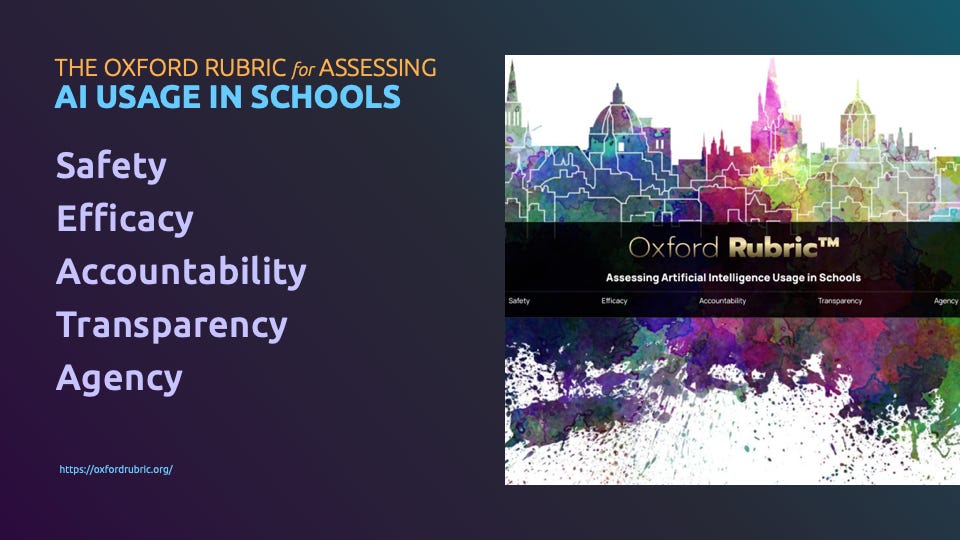
This rubric works as foundational when thinking about AI in education, not as a set of rules to blindly follow, but as a lens through which every AI policy should be evaluated. The rubric lays out five essential pillars:
1. Safety: Protecting Students and Securing Digital Environments
Safety is paramount. Students must feel secure in the digital environments where AI tools operate. If students don’t trust that their data is protected, or that they are safe from harmful content, no amount of AI-powered innovation will matter.
Without that feeling that the student is safe and secure in the digital environment, any policy you make towards AI will be useless. This means schools must put strong technical safeguards in place, protect privacy rigorously, and ensure AI tools are age-appropriate and free from bias or harmful content. Safety builds trust, and trust is the foundation of learning.
2. Efficacy: Does the AI Actually Improve Learning?
An AI tool might be safe, but is it effective? The Oxford Rubric asks educators to consider whether AI genuinely improves educational outcomes. It’s not enough for AI to simply provide answers or generate content; it needs to help students understand why and how they arrive at those answers.
It focuses on the ‘what’ provided by AI, while requiring humans to provide the ‘why.’ AI should be a partner that fosters critical thinking and deeper comprehension, not a shortcut that bypasses learning.
3. Accountability: Who Is Responsible?
One of the thorniest issues with AI is accountability. When AI generates content—be it essays, images, code, or answers—who is responsible if that content is incorrect, plagiarized, or harmful?
Only humans can take responsibility for the messages that come from their own ”pen”. It is not enough to say, ‘Oh, it was the AI’s fault.’ Schools and teachers need clear policies defining human responsibility for AI outputs. Students must understand that using AI does not absolve them from accountability for their work.
4. Transparency: Clear, Open Use of AI
Transparency means everyone—teachers, students, parents—should understand when and how AI is being used. There should be no “black box” AI quietly operating behind the scenes without explanation.
The rubric encourages openness about AI’s role in education. In this regard, educators need to be role models for ethical AI use: “Educators and students should understand when and how AI is being used. They should make clear distinctions between human creativity and AI-generated receipts for that creativity.” For example, if a student submits an AI-generated paper, they should disclose it honestly rather than passing it off as entirely their own original work.
5. Agency: Maintaining Human Control Over the Learning Process
Perhaps most importantly, the rubric insists that humans retain control. AI is a tool to augment human creativity and learning—not replace it.
Let me underscore this point from the rubric: The human has the right to drive the creative act. AI remains a collaborative partner rather than a replacement.
This means teachers and students should always be able to guide the AI, make final decisions, and shape the learning process according to human values, goals, and ethics.
Why does the Oxford Rubric Matter?
The Oxford Rubric matters because it helps educators harness AI responsibly—balancing innovation with safety, efficacy, accountability, transparency, and agency. It’s a tool to keep human creativity and judgment front and center in an AI-transformed classroom.
In a world where AI is advancing faster than many policies can keep up, the Oxford Rubric offers a roadmap to balance innovation with responsibility. It reminds us that AI is not just about technology—it’s about people, ethics, and education.
Because AI’s pace and power can feel overwhelming. Without clear principles, well-intentioned teachers might adopt AI tools haphazardly, risking student privacy, learning quality, or ethical integrity.
The Oxford Rubric offers a shared language and framework that helps schools design AI policies that protect students, uphold educational values, and promote genuine learning.
Developing AI Policies for Your School
Here is my advice for educators looking to embrace AI responsibly:
Develop clear, consistent, and easily understood policies tailored to your school, department, classroom, students, and even you. Everyone should know the rules and expectations around AI use And you will need to lead by example.
Use AI as a tool where you lack skills or time. For me, this means using AI to transcribe lectures or draft marketing copy—tasks I’d rather delegate or have no talent for myself so I can focus on creative teaching. It is important to note, though, that I review and edit all copy.
Respect ethical concerns. Don’t force students to use AI if they are uncomfortable. Provide alternative assignments or approaches.
Invite innovation and debate. Encourage students to share how they use AI creatively and foster open discussions about AI’s impact on humanity.
Developing AI Ability in Your Classroom
Policy is only the start. Here’s what I practice:
Develop clear, simple AI policies for your school, department, and classroom. Make sure students and colleagues understand them.
Use AI where you lack time or skill—like transcribing lectures or writing marketing copy.
Don’t force students to use AI if they have ethical concerns. Provide alternatives.
Design “AI-proof” assignments. For example, I had students track website evolution using the Wayback Machine, taking screenshots and writing analyses. AI could maybe do it, but it wouldn’t be faster or better—and it taught real skills.
Invite students to share creative AI uses and encourage open debate about AI’s future.
Final Thoughts
Teaching has always been first and foremost about teaching creative thinking. It takes much more than the memorization and application of facts to be creative. It’s about inspiring curiosity, nurturing growth, and helping students find their voice. That’s what we do best—and what AI can never take away. John Cleese said it best: “Creativity is not a talent. It is a way of operating.” And here’s the kicker: If you’re not having fun, you’re not being creative. Playfulness the unlocks creativity.
If you want to talk more about creativity, AI, or teaching, email me at jason@cranfordteague.com or visit cranfordteague.com.